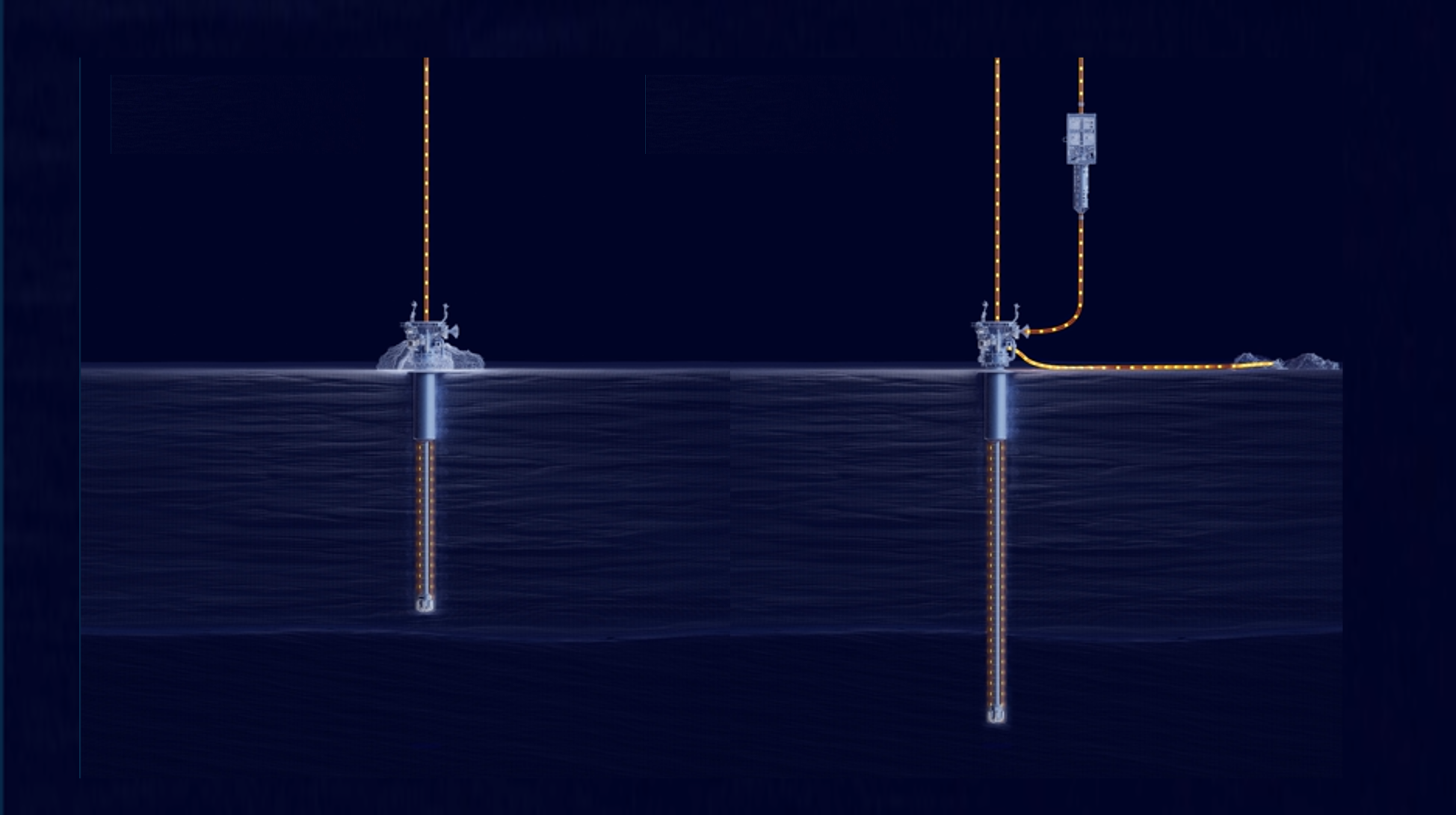
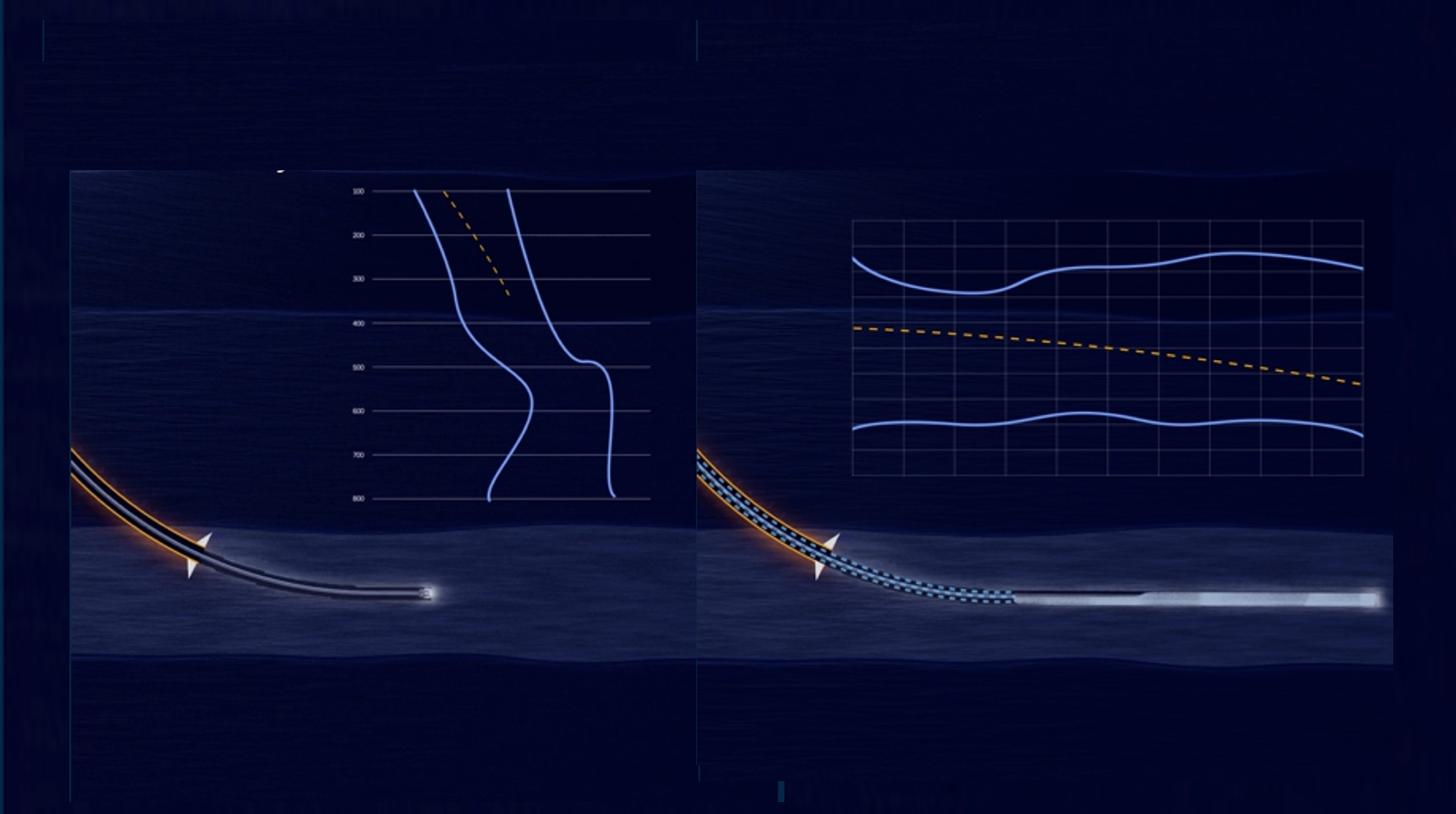
Controlled Mud Level (CML) was initially introduced to enable drilling in wells where conventional approaches struggled to operate within the pressure window.
Today, the role of CML has expanded beyond drillability alone. In many offshore wells, particularly in deepwater and narrow margin environments, CML is used to support well design optimization, reduce operational constraints and improve completion results.
This article outlines some of the main operational and economic drivers behind the use of CML today.

Dual Gradient Effect: Improving well architecture
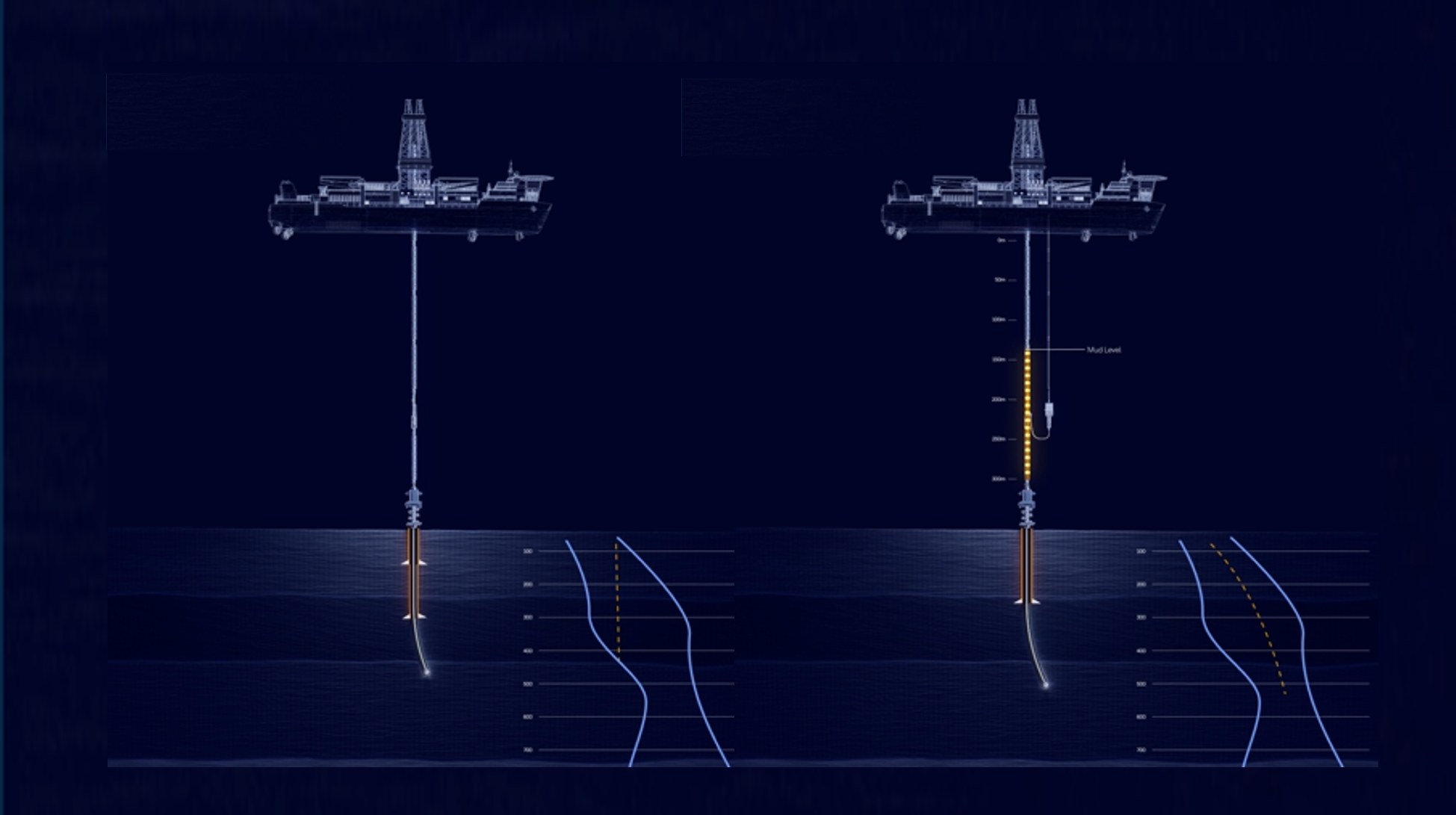
The Dual Gradient Effect is created when the fluid level in the riser is lowered, replacing part of the fluid column with air. This results in a curved static pressure profile with a lower pressure gradient at shallower depths.
This profile aligns better with common operating windows. In some cases, pressure adjustments between static and dynamic conditions are not required, even in wells with narrow margin. This can itself be a significant operational advantage.
The Dual Gradient Effect is actively used to combine sections and eliminate a casing or liner. The direct savings are relatively straightforward to quantify, for example through one less casing or liner and one less cement job. In addition, a simpler well architecture can provide indirect cost benefits through:
- More standard bit and casing sizes
- Less requirements for reaming
- Larger hole size in the reservoir
The Dual Gradient Effect is illustrated in the graph below, where no pressure adjustments are made between static and dynamic conditions.
In this example, the large hole size in the upper section of the well does not generate high ECD, allowing the pressure profiles to remain below the Fracture Gradient of 1.33 SG (11.08 ppg) at the shoe while staying above the Pore Pressure of 1.43 SG (11.91 ppg) at sectional TD. Under these conditions, connections can be performed without pressure adjustments between static and dynamic states.
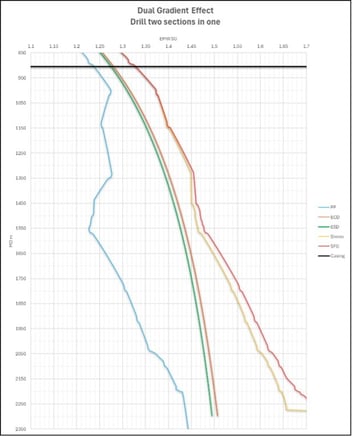 Example of how the Dual Gradient Effect changes the pressure profiles in a narrow pressure margin well without pressure adjustments between static and dynamic conditions. The Green curve shows the static pressure profile, while the Orange curve shows the dynamic pressure profile (ECD).
Check out: What to Consider When Implementing MPD in Deepwater
Optimization as an MPD tool
When it is necessary to use MPD to enable drilling, CML will optimize those drilling operations. The flat time associated with MPD can be high in narrow windows:
Avoiding Fluid Displacements
After drilling a section, the well must first be displaced to a heavier tripping fluid before pulling out. The casing must then be run in slowly in the high-density tripping fluid, without exceeding the upper boundary of the well. The well is then displaced a second time to a cementing fluid. This displacement can be painfully slow because of the narrow annulus between the casing and the open hole – and the heavy tripping fluid being displaced out.
CML can eliminate this flat time by adjusting the riser level instead of relying on multiple fluid displacements. No displacements are needed as the fluid level is adjusted according to ongoing operation. Tripping can be sped up by facilitating a better margin towards the pressure boundaries in the well.
Tripping Operations
Using the same example in the previous section, the two graphs below show tripping out with the BHA (left) and then running in hole with the casing (right).
Before tripping out, the fluid level is increased to move the static pressure profile away from the pore pressure. Before running the casing, the fluid level is lowered to increase the margin towards the fracture gradient.
These adjustments can improve operational margins during tripping and casing running operations without relying on multiple fluid displacements.
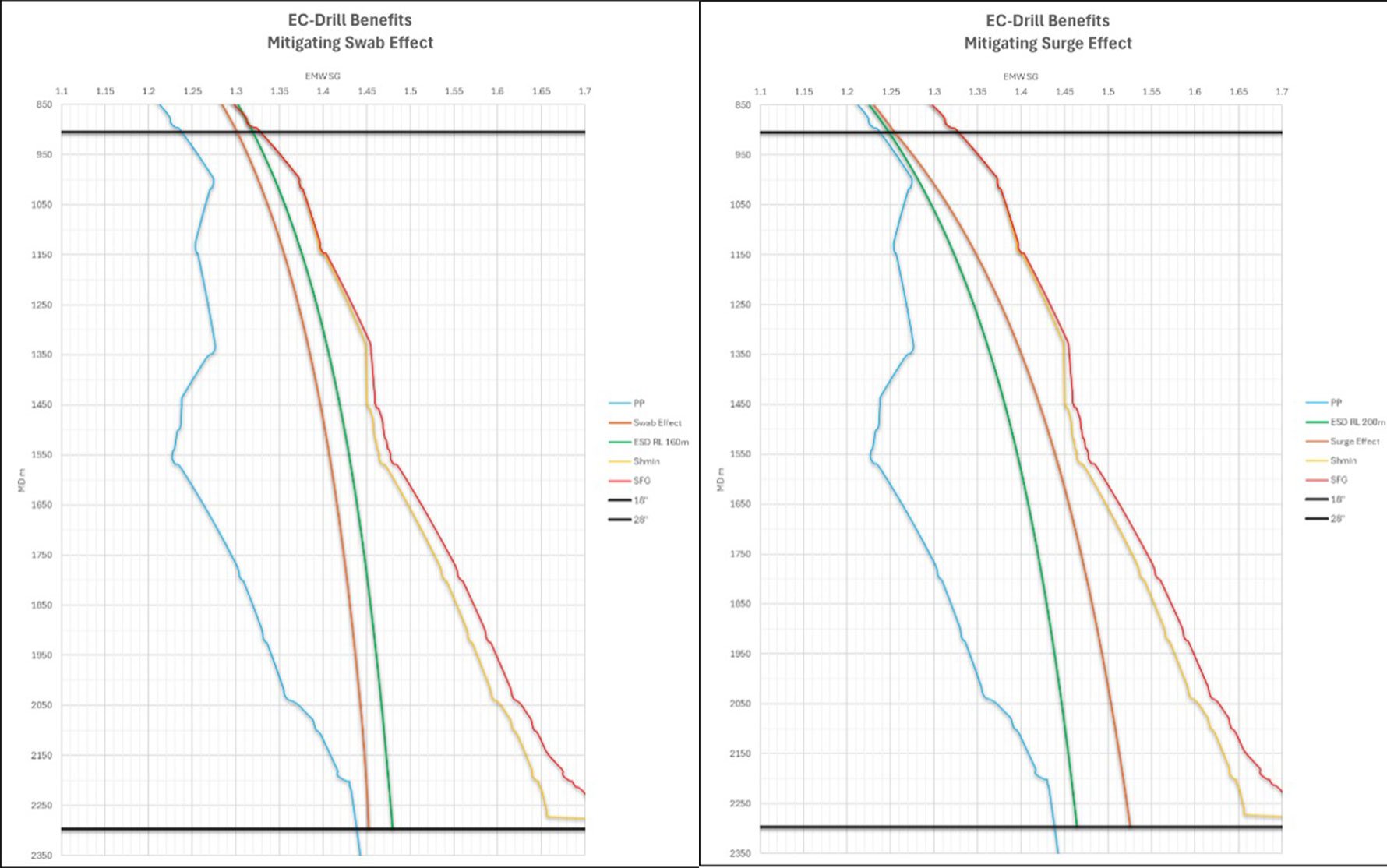 Example of how riser level adjustments shift the pressure profile during tripping operations. The Green curves show the static profiles, while the Orange curves show the resulting swab and surge pressure profiles respectively.
Cementing Operations
The ensuing cement job is done by lowering the riser level in steps as the heavier more viscous cement goes up the annulus.
This allows the pressure profile to be adjusted throughout the cementing operation without relying on additional displacement sequences. In narrow margin wells, this can improve operational flexibility during cement placement.
Additional reading: What Are Undrillable Wells in 2025 and How to Make Them Drillable
Boosting Completion Performance
CML is just as valuable during completions – especially for Open Hole Gravel Pack (OHGP).
In OHGP, CML achieves a full screen-out without going on losses. This is done by adjusting the riser level as the gravel-laden fluid backfills (Beta wave) towards the heel of the reservoir section.
CML also supports the use of drill-in fluids for reservoir sections, reducing skin damage and enabling higher production rates. It expands the range of densities available for drilling and completion fluids, which can be a major operational advantage.
Completion performance is, in many applications, one of the main operational drivers for using CML. In these cases, the potential value comes from improved production performance rather than direct drilling cost reductions.
These benefits are also among the most difficult to quantify before a project starts. However, there are historical cases where production from offset wells has been compared with wells completed using CML. There is also a case where a sidetrack completed with CML was directly compared with the original completion.
Although production impact can be difficult to quantify upfront, early involvement from the subsurface team can help assess the potential benefits.
Takeaway
CML is still used to drill wells otherwise considered undrillable. But the industry mindset has evolved.
Now, cost savings and optimization are often the primary reasons for choosing CML. Whether it’s simplifying the well architecture, speeding up operations, or increasing production – CML is delivering value across the well lifecycle.
The question is no longer only: “Can we afford to use CML?”
But increasingly: “Can we afford not to?”

Get the latest updates
Want to stay updated on the latest knowledge articles and news from Enhanced Drilling?